AI Attractiveness Test
How attractive am I? Take a free AI attractiveness test to see your photo score, facial highlights and proportions—all analyzed on your device.
Drop a photo here
Free·No sign-up·Your photo stays on your device
No photo handy? Try an example.
AI-generated example portraits

AI-generated example
86
Radiant
Top 33%
On our 60–99 scale
Highlights
Compact lower face
Your lower face sits short beneath your midface.
Well-proportioned eyes
Your eye size sits within the typical range, in easy proportion to your face.
Even eye spacing
The space between your eyes sits within the typical range.
Drop your photo to start
It stays on this device.
How attractive am I? What this test can tell you
This test gives your photo an AI face rating on a 60–99 scale, a named band and facial highlights. It also describes visible proportions such as eye spacing and jaw width. The score and the proportion readings come from different parts of the analyzer.
Score
86
A number from 60 to 99 for this photo, on this test's own scale. An image model trained on people's ratings produces it.
Band
Radiant
One of four: Natural Charm, Glowing, Radiant or Dazzling.
Highlights
Compact lower face
Up to three features that stand out, from measurements of your face. They are not part of the score.
Readings
Eye spacingBalanced
Five plain descriptions of your proportions. They are not scored and do not add up to the score.
Values from the AI-generated example at the top of the page, as the current model scored it.
How does the face attractiveness test work?
Choose a photo and your browser does the rest. An AI model that learned from how people rate faces scores the photo, and separate face measurements pick your highlights and readings. Everything runs on your device; the first test also downloads the analyzer once.
Choose a clear photo
Face the camera and keep your eyes, forehead and chin visible. You can try an example first.
Your browser analyzes it
The analyzer runs on your device. Your photo is not uploaded by the test.
Read and save your result
See your score and highlights, explore the available readings, then save your result or try another photo.
For adults 18+. Use a photo of yourself, or one you have permission to use.
What is a good attractiveness score?
On this test, 80–89 is the Radiant band and 90–99 is Dazzling. These bands belong to our own 60–99 scale, based on a reference set of photos. They are not directly interchangeable with another site's 1–10 rating.
If a Top percentage appears, it refers to the test's reference photos, not the world's population.
Natural Charm · This result
Below most of the reference photos. Angle, distance and expression all move a photo.
Glowing · This result
Just below the middle of the reference photos.
Radiant · This result
Above the middle of the reference photos.
Dazzling · This result
Roughly the top quarter of the reference photos.
Is a 90 a good score?
Yes. 90 is where Dazzling, the highest band, begins. A photo at 90 or above scored higher than roughly three in four of the reference photos.
Can I turn it into a 1–10 rating?
No. 60–99 is this test's own scale, so an 84 here is not an 8.4 somewhere else, and a 7.5 from another tool can't be converted into this scale. Different tools use different photos and raters.
What does "Top X%" mean?
Top 26% means this photo scored higher than about 74% of the 3,704 studio-style reference photos the test compares with. It is not a rank among all people, and it only appears for scores above the middle of that set.
Why does the scale start at 60?
Scores are placed along the reference photos: a photo that scores higher than none of them gets 60, one that scores higher than all of them gets 99, and the middle of the set lands at about 80. So 80 is the middle of the reference photos, not the average of everyone who takes the test.
What do your facial highlights mean?
Your browser finds points on your face and measures a few proportions, such as eye size, jaw width and the length of your lower face. Each one is compared with a broad mix of people, and up to three that stand out become your highlights. They describe your face; they are not pieces of the score.
A strong highlight says "than most". A middle one says a feature sits in the typical range, which is also where most attractive faces sit. Some angles hide a measurement, so not every photo gets three "than most" highlights or all five readings.
The highlights you can get
Bright, open eyes
Your eyes read larger than most.
Harmonious features
Your features sit close to the natural average shape, which people consistently find appealing.
Compact lower face
Your lower face sits short beneath your midface.
Even eye spacing
The space between your eyes sits within the typical range.
Proportioned jaw
Your jaw width is in easy proportion to your face.
Balanced brow line
Your brows sit at a typical, natural height above your eyes.
Balanced lips
Your upper and lower lip sit within the typical proportion.
Proportioned face
Your face width sits within the typical range for your features.
Eyes, features and lower face also come in a gentler wording when your measurement sits closer to the middle.
What the five readings describe
- Eye size
- Refined, Balanced, Large
- Eye spacing
- Close-set, Balanced, Wide-set
- Brow height
- Low-set, Balanced, Lifted
- Lower face length
- Short, Balanced, Long
- Jaw width
- Tapered, Balanced, Broad
Readings describe your face. They are not scored, there is no right answer, and they do not add up to your score. If your head is turned or tilted up or down, a reading says "Not measured" instead of guessing.
The readings don't include the angle of your eyes. To measure whether your outer eye corners sit higher or lower than the inner ones, try the canthal tilt test.
Jaw width and these proportions are not a face shape. To explore your face shape as a starting point for styling, try the Face shape detector by Style Look Lab.
Compared with everyone
"Than most" means most people across every background, men and women counted equally. Not every face gets a "than most" highlight. When yours are balanced, that is where most attractive faces sit.
Skin is left out of the highlights
Skin changes most with light, filters and makeup, so the highlights and readings never describe it.
Nothing drawn on your photo
You won't see a "potential" score or a list of things to change, and no lines or points are drawn over your face.
Why can different photos get different scores?
The test scores the photo, not the person. Light, angle, distance and expression all change how a face reads, so three photos of you can get three different scores. For the steadiest result, use a clear photo that faces the camera, in soft light from the front, taken at eye level from about an arm's length away.
One face, three photos
AI-generated illustrations of one fictional person in three common conditions, each run through the current model. Because the images were generated, other details can differ too, so read them as examples of how these files score, not as a controlled experiment.

Facing a window, eye level
90·Dazzling
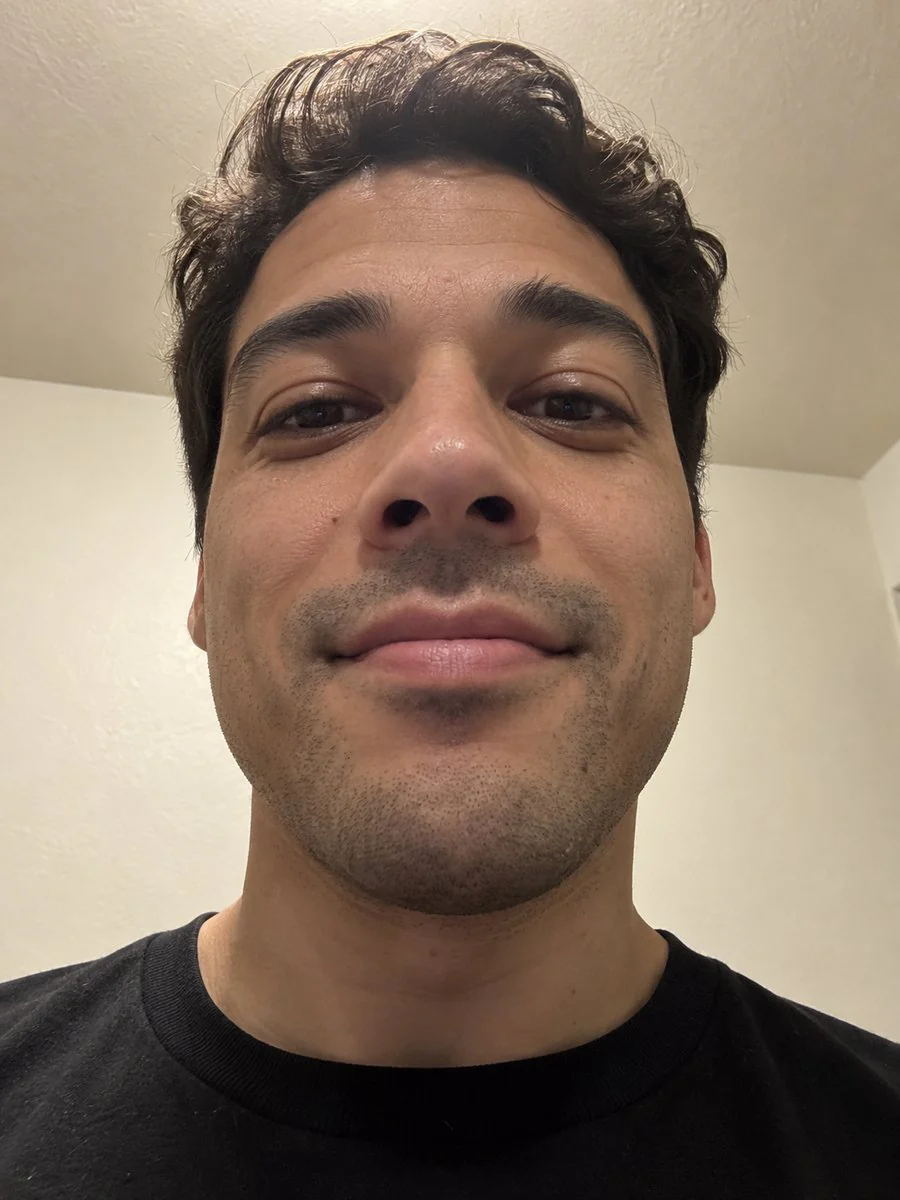
Held low and close
83·Radiant

Backlit, head turned
84·Radiant
For a steadier score
Which photo of me is best?
Run the attractiveness test on a few photos in a row. Each result stays in "This session" while the tab is open, so you can see which photo reads best for a dating profile, a new avatar or a CV photo. Nothing is saved, and the list disappears when you close the tab.
- Pick three to five recent photos that face the camera.
- Test them one after another. Tap any photo in "This session" to see its result again.
- Keep the photo with the highest score, and check that it still looks like you on a normal day.
How accurate is this attractiveness test?
Three different checks answer three different questions. The examples show the test spreading different faces across the scale. The repeat runs show the same file getting the same score. How closely scores follow people's ratings is measured on rated photo sets and reported on the method page. It is still a score for one photo, not a fixed truth about you.
Different faces, different scores
64
Natural Charm
80
Radiant
89
Radiant
97
Dazzling
Four AI-generated example photos, made the same way, spread from 64 to 97. Tap one to see its full result. They show the test using the whole scale; four examples are not a measure of accuracy.
Same photo, same score
Each example was run three times in a row with the current model. The model's output was identical every time, so the score was too. Asking a chatbot the same question twice does not guarantee that.
| Photo | Run 1 | Run 2 | Run 3 |
|---|---|---|---|
| Example 1 | 89 | 89 | 89 |
| Example 2 | 80 | 80 | 80 |
| Example 3 | 97 | 97 | 97 |
| Example 4 | 64 | 64 | 64 |
What a photo can't tell you
What else we checked
Is my photo uploaded or stored?
Your photo, facial measurements and score stay on your device. The test does not upload them or use your photo to train the model. You can save a result image to your device without an account.
We use Google Analytics to count how many tests start and how many give a result. Those counts never include your photo, score or face measurements.
Check it yourself
- Open your browser's developer tools and switch to the Network tab.
- Choose a photo on this page.
- You will see the analyzer download once, and no request carrying your photo.
Can ChatGPT rate my face instead?
You can ask a chatbot or a rating forum. The differences are the scale, where your photo goes and what you need to sign up for. This test gives the same file the same score, on a 60–99 scale with four bands, and analyzes the photo on your device.
| This test | Asking a chatbot | Rating forums | |
|---|---|---|---|
| Where your photo goes | Stays on your device | Sent to the service | Posted publicly |
| Same photo, same score | Yes | Not guaranteed | Depends on who replies |
| Scale | 60–99 with four bands | Whatever you ask for | Varies |
| Account | Not needed | Usually needed | Needed to post |
| Cost | Free | Free or paid | Free |
What makes a face attractive?
People agree about faces more than the saying "beauty is in the eye of the beholder" suggests. Studies across many countries find that raters tend to rank the same faces in a similar order. A few patterns show up again and again, and none of them is about a single "perfect" feature.
These are findings from published research in general. They explain the idea behind the test; they are not a check of this model's accuracy.
Close to average
Faces whose proportions sit near the average of a population are rated well. Blending many faces together tends to produce an attractive face, which is why "typical" is not a polite word for plain.
Symmetry matters less than you think
It is the famous one, but in real photos the effect is small. Most of the asymmetry a camera sees comes from head angle and lighting, not the face itself.
Expression and light
A relaxed expression and soft, even light make a face read as warmer and more attractive. That is why the same person gets different scores in different photos.
Taste still varies
Agreement is strong on average, but every person has their own type. A score predicts a crowd, not the one person who matters to you.
Not the golden ratio
The golden ratio is popular online, but studies have not found that faces matching it are rated more attractive. This test does not use it.
More than a photo
In person, people respond to how you move, sound and laugh. A still photo captures only part of that.
Frequently asked questions
Quick answers before and after you take the test.
Am I pretty? Am I attractive?
This test tells you how one photo of you reads on a 60–99 scale, and what stands out on your face. How attractive you are in person, with your voice, expression and style, is bigger than any photo.
How do I get my face rated?
Choose a clear photo that faces the camera, or try an example first. Your browser analyzes it and shows a score, band and highlights. How it works ›
Is a 90 face score good?
Yes. 90–99 is Dazzling, the highest band on this test's 60–99 scale. What the scores mean ›
How attractive am I on a scale of 1 to 10?
This test doesn't use a 1–10 scale, and its score can't be divided by ten to get one. A 7.5 from another tool and an 84 here come from different scales and different reference photos.
What is the average attractiveness score?
80 is the middle of the test's reference photos: about half of them score higher. It is not the average of everyone who takes the test, and everyday selfies spread more widely.
Why can't I get a score below 60?
The scale places your photo along the reference photos from 60 to 99, so 60 is the bottom of the scale.
Does age affect my score?
Yes. Most of the ratings the AI learned from were of young adults, and photos of older people score clearly lower. Compare photos of the same person rather than people of different ages.
Why did another photo get a different score?
Light, angle, distance and expression all change how a face reads. Why photos score differently ›
Why do I look different in the mirror than in photos?
A mirror shows you flipped and in motion, and you are used to that view. A camera shows the other side, often closer and with a wider lens, which changes proportions.
Does symmetry matter?
A little, less than most people think. Most of the asymmetry a camera sees comes from head angle and lighting, not the face itself. This test does not give a separate symmetry score.
What do my highlights mean?
They are up to three proportions of your face that stand out compared with a broad mix of people. They are not part of the score. How highlights work ›
Is this face attractiveness test free?
Yes. The test, the result and the result image are free, with no account, email or payment.
Is my photo uploaded or used to train AI?
No. The photo is analyzed in your browser. The test does not upload it or use it to train the model. Privacy ›
Can ChatGPT rate my looks?
You can ask it, but the scale, the answer and where your photo goes are different. Compare the two ›
Can I test a group photo?
Yes. The test finds each face, and you tap one to see its result. Faces that are too small in the frame are listed but not scored, so two or three people side by side work best.
Can I save a result without the photo?
Yes. The result image can be saved with or without your photo. It is made on your device.
Can I come back to my result?
While the tab stays on this page, every photo you test is listed under "This session". Refreshing, leaving the page or closing the tab clears it, because nothing is stored.
Does it work for men and women, and every skin tone?
Everyone gets the same scale and the same wording, and you are never asked your gender. How this model version was checked across skin tones is on How it works.
Can I use it to choose a dating profile photo?
Yes. Test a few photos in a row and compare them under "This session". Pick the one that scores best and still looks like you.
Is this a beauty test, a pretty scale or a face rating?
Same idea, different names: beauty test, pretty scale, face rating, rate my face, hotness test. This AI attractiveness test rates one photo on a 60–99 scale.
Is this the same as a PSL rating?
No. PSL is a separate scale used on looksmaxxing forums. This test's 60–99 score is not a PSL rating and is not converted to one.
Can I test a photo of someone else?
It will run on any face. Please don't. Everyone deserves to decide whether they want a number attached to their face.
Ready to take the attractiveness test?
Free, and your photo stays on this device.